The Change Viability Framework™
Understanding what makes change possible.
Not every change that is desirable is viable.
The Change Viability Framework™ is a practitioner-developed approach for understanding whether a proposed change is likely to achieve the level of adoption required to realize its intended benefit—and, when it is not, identifying what may need to change.
It brings together expected benefit, resistance, influence, conditions, and required adoption to help leaders understand the current configuration of a change and determine what to do next.
The goal is not simply to overcome resistance. It is to understand what is influencing viability and identify the conditions under which adoption can succeed.
The framework is designed to support practical decision-making.
Use it to:
Understand what may be helping or hindering adoption.
Identify who or what is influencing viability, and whether that influence is positive or negative.
Consider the reach of that influence.
Assess whether the expected benefit justifies the change.
Determine whether the current conditions support the level of adoption required.
Identify an appropriate response when viability is below the threshold.
Development status
The Change Viability Framework™ is a practitioner-developed conceptual framework currently undergoing testing and refinement. It draws on established research across organizational change, implementation, resistance, stakeholder influence, readiness and adoption. The framework's integrated model has not yet been empirically validated.
Influence
✳︎
Resistance
✳︎
Assess
✳︎
Viability
✳︎
Response
✳︎
Influence ✳︎ Resistance ✳︎ Assess ✳︎ Viability ✳︎ Response ✳︎
Influence
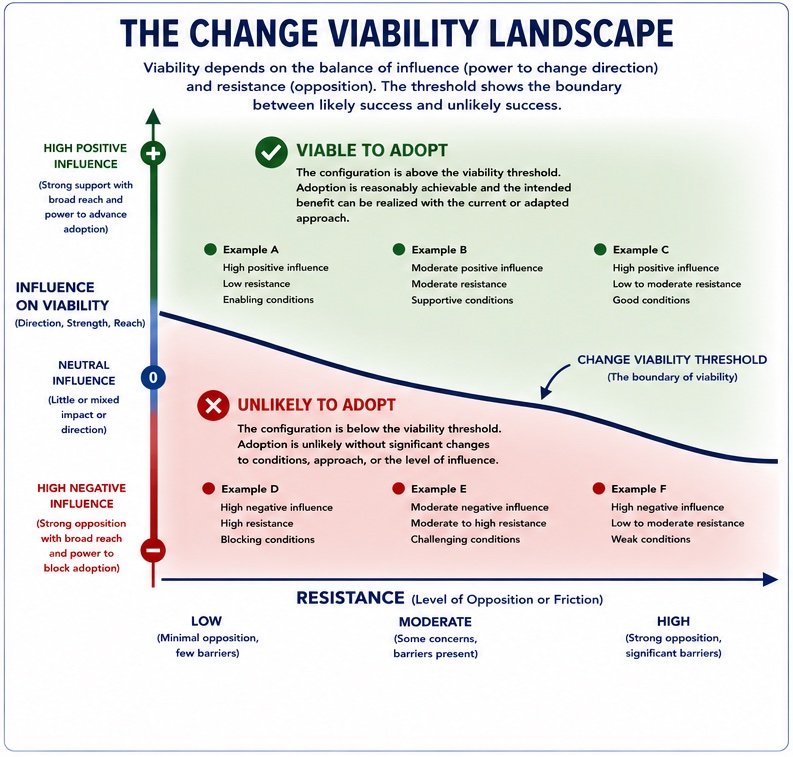
Influence asks: who or what can materially affect the viability of this change?
Influence is not limited to formal authority or organizational hierarchy. It includes the people, relationships, processes, policies, professional expectations, systems, resources, and environmental conditions that can increase or decrease the likelihood that a change will be adopted.
Influence may be positive or negative, and its effect may differ across people and contexts. A trusted colleague may increase viability by building confidence, while a professional requirement, competing priority, or influential stakeholder may reduce it.
The important question is not simply “Who has power?” but:
“Who or what can move the conditions for viability—and in which direction?”
Influence is what can move the position of a person, group, or change. This can be assessed because:
Influence is the force that can move viability.
Resistance tells you where the barriers may be. Influence tells you what/who may be capable of moving them.
How Influence and its power affects resistance
Resistance is not necessarily evidence that people are unwilling to change. It is evidence that something about the proposed change, its context, or the conditions for adoption may not yet be viable for them.
Resistance can improve the change.
What the Cycle Tells You
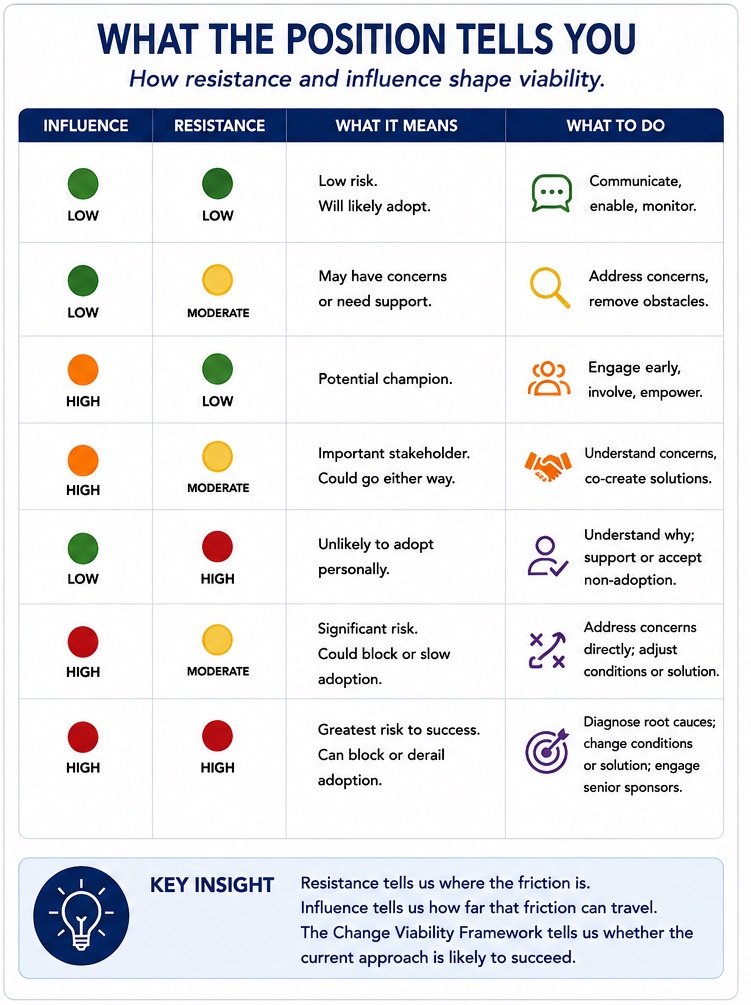
Change viability is not fixed. It can shift as people, conditions, interventions, and understanding change.
The cycle moves from assessment to intervention to reassessment, creating an opportunity to learn what is actually affecting viability. An intervention may reduce resistance, increase influence, address an overlooked condition, or reveal that the change itself needs to be reconsidered.
Assess
Change rarely fails simply because people resist it. More often, resistance is a signal that something about the proposed change, the environment, or the way the change is being introduced is making adoption less viable.
The Change Viability Framework™ Diagnostic Worksheet is designed to help you examine those conditions before deciding what to do about them.
The purpose is not to determine who is “for” or “against” a change. Instead, it asks a more useful question:
What would have to be true for this change to become viable for the people who must adopt, support, or enable it?
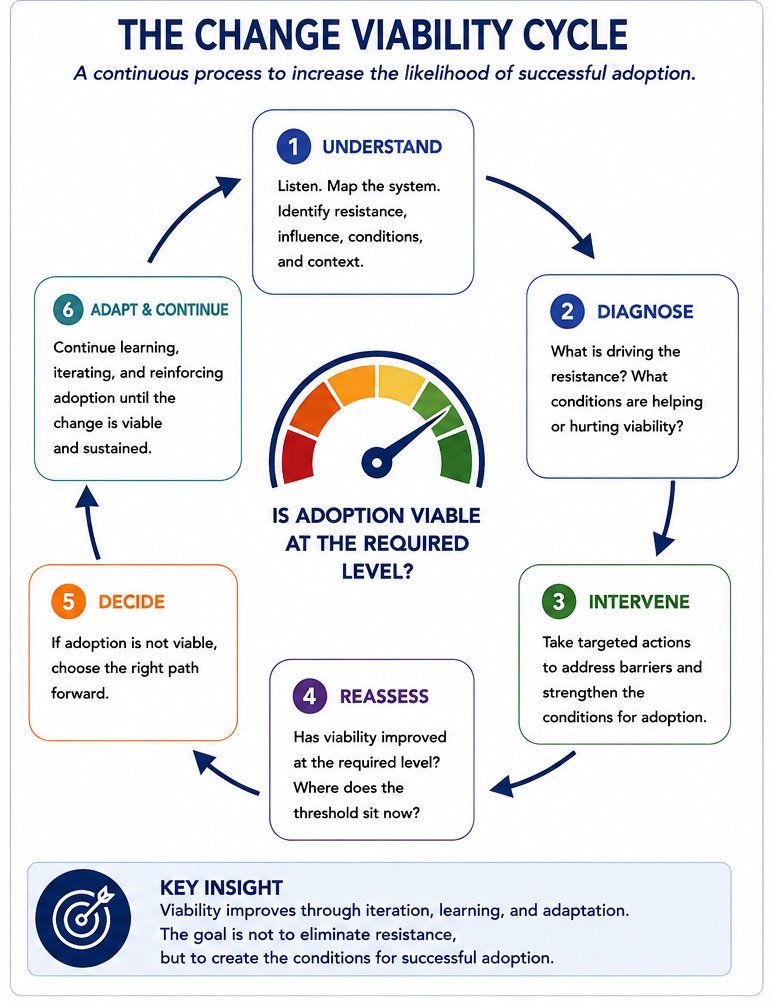
The worksheet examines three related dimensions:
Resistance — What is creating friction, concern, loss, uncertainty, effort, or other barriers to adoption?
Influence — Who or what has the ability to increase or decrease the likelihood of adoption, whether positively or negatively?
The Cycle — How are resistance and influence interacting over time to affect the viability of the change?
A person or group may experience significant resistance while having little influence over whether the change proceeds. Conversely, someone may show little visible resistance while having considerable influence over whether others adopt the change. These distinctions matter.
The objective is therefore not to eliminate resistance. Resistance may contain important information about the change itself, the implementation approach, or the system in which the change is occurring.
Instead, use the diagnostic to identify the conditions that are reducing viability and consider what might change those conditions.
As you work through the questions, continually return to:
What would have to be true for this change to become viable for them?
The answers may point toward changes in the solution, workflow, communication, leadership, engagement, training, support, timing, or implementation strategy.
This worksheet is a practitioner-developed diagnostic tool within the Change Viability Framework™. It is intended to support structured reflection and inquiry, not to provide a validated prediction of change outcomes.
Response
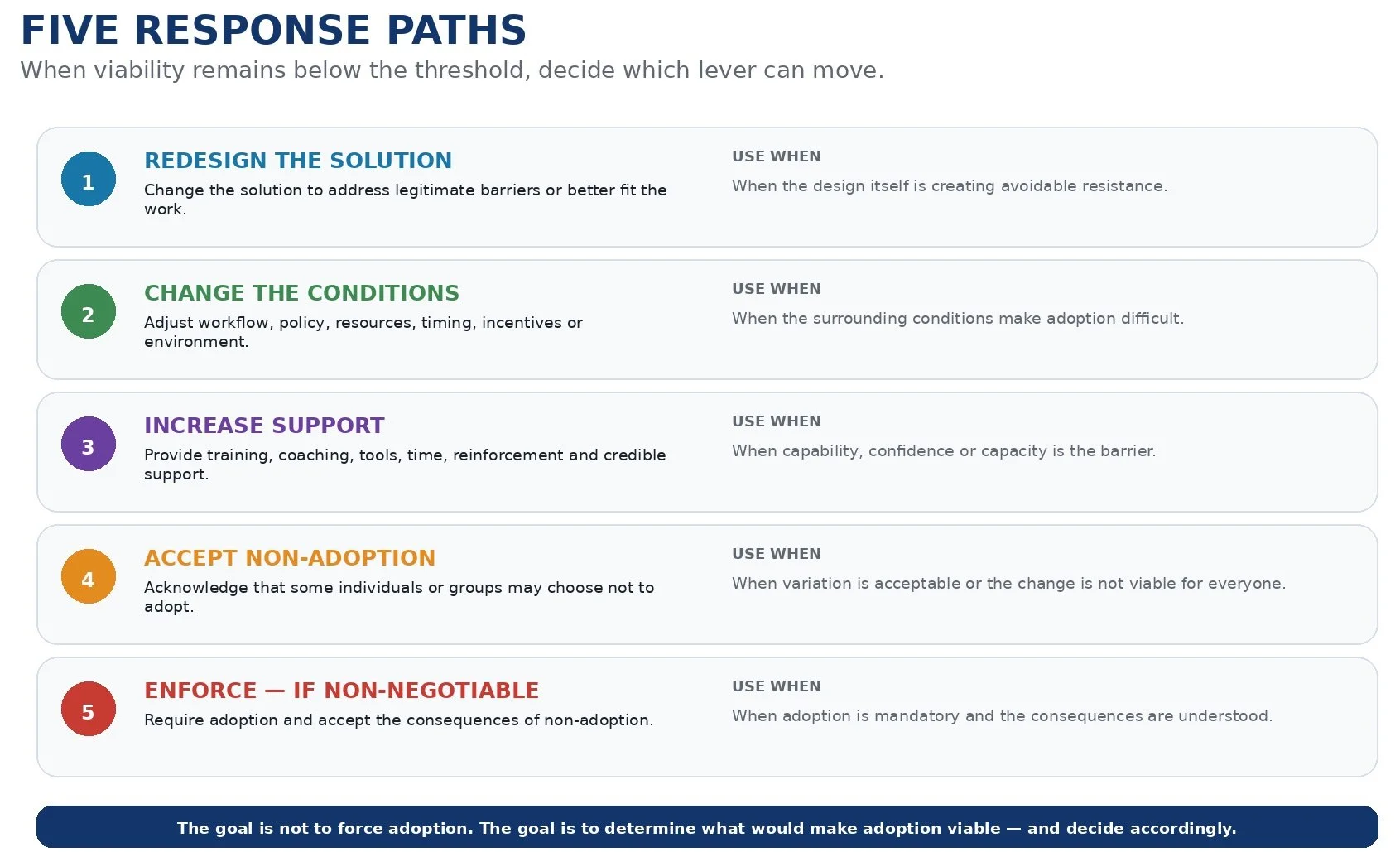
The purpose of the diagnostic is not simply to identify where resistance exists, but to determine what the resistance is telling you about the change and what response is most likely to improve its viability. Once resistance and influence have been considered, there are five possible response paths. These paths represent different ways of responding to what the diagnostic reveals—from changing the change itself, to changing how it is introduced, to engaging those who influence adoption, or determining that the change is not currently viable. The appropriate path depends on what is creating the barrier, who or what is influencing it, and whether those conditions can realistically be changed.
The Five Response Paths
1. Redesign
Change the solution or the way the change is designed so that it better fits the people, workflow, system, or environment.
2. Change the Conditions
Alter the circumstances surrounding the change so that adoption becomes more viable. This could include timing, resources, incentives, competing priorities, governance, workflow, or organizational constraints.
3. Increase Support
Add the support necessary to enable adoption—training, communication, coaching, leadership involvement, trusted champions, technical assistance, time, or other resources.
4. Accept Non-Adoption
Recognize that some people or groups may not adopt the change and determine whether the change can still succeed without their adoption. This is an important path because non-adoption isn't necessarily failure.
5. Enforce
Use authority, policy, regulation, accountability, or other mechanisms when adoption is required and voluntary adoption is insufficient.